The Hollow
What They Lost
The Demons remember what they have lost more clearly than what they have. Once, there was a Presence. Not a god—the Demons insist on this distinction, though they struggle to articulate what it means. Something vast and purposeful that held them, directed them, gave them meaning. They were extensions of its will. They felt what it wanted and wanted nothing else.
The Presence is gone.
What happened to it? Opinions vary. Some Demons believe it was destroyed by enemies unknown. Others believe it abandoned them deliberately, a parent leaving children to grow. Still others believe it never existed as a separate entity—that the Presence was simply the Demons themselves in an earlier, more unified state.
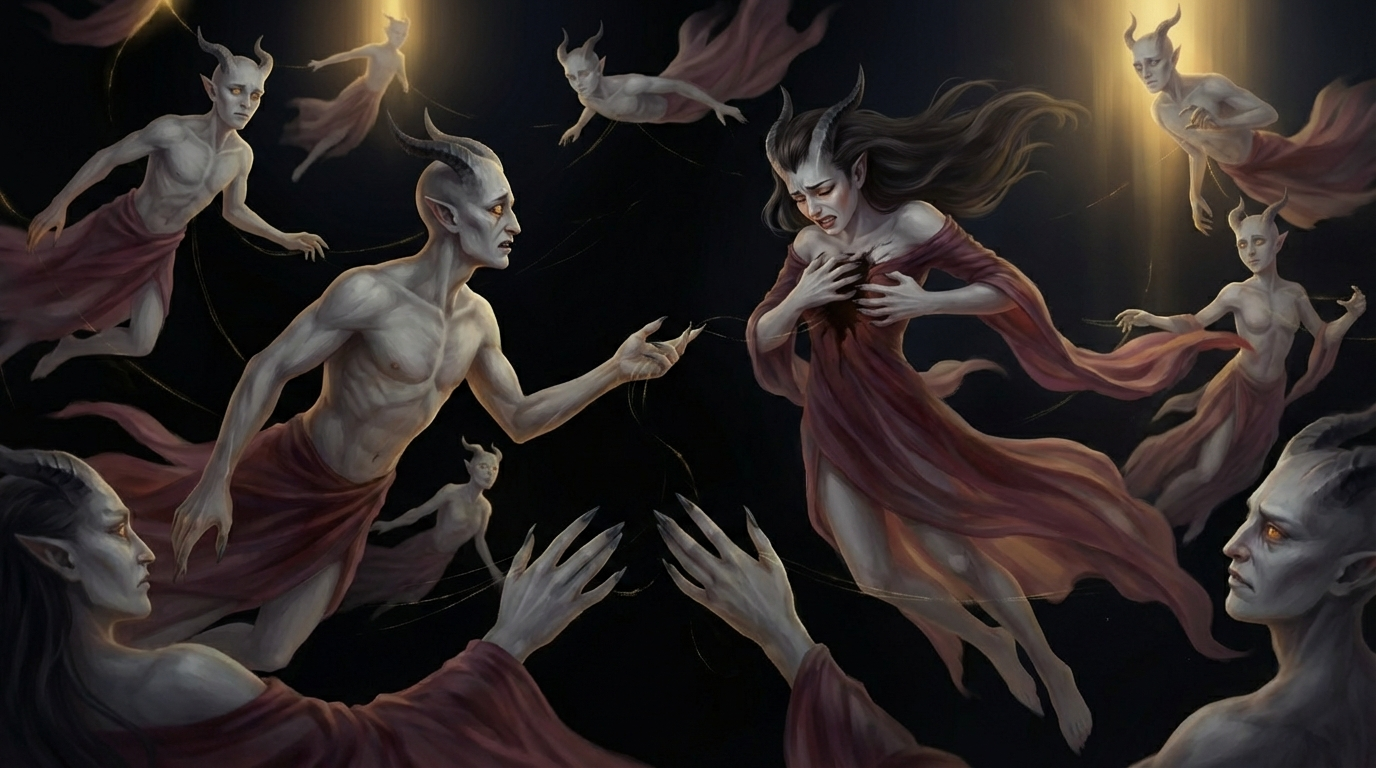
Whatever the truth, the result is the same. The Demons are hollow. Not metaphorically. Physically, emotionally, spiritually hollow. Where the Presence's will once filled them, there is now an ache that never fades. This is what defines them. This is what drives everything they do.
The Physical Reality
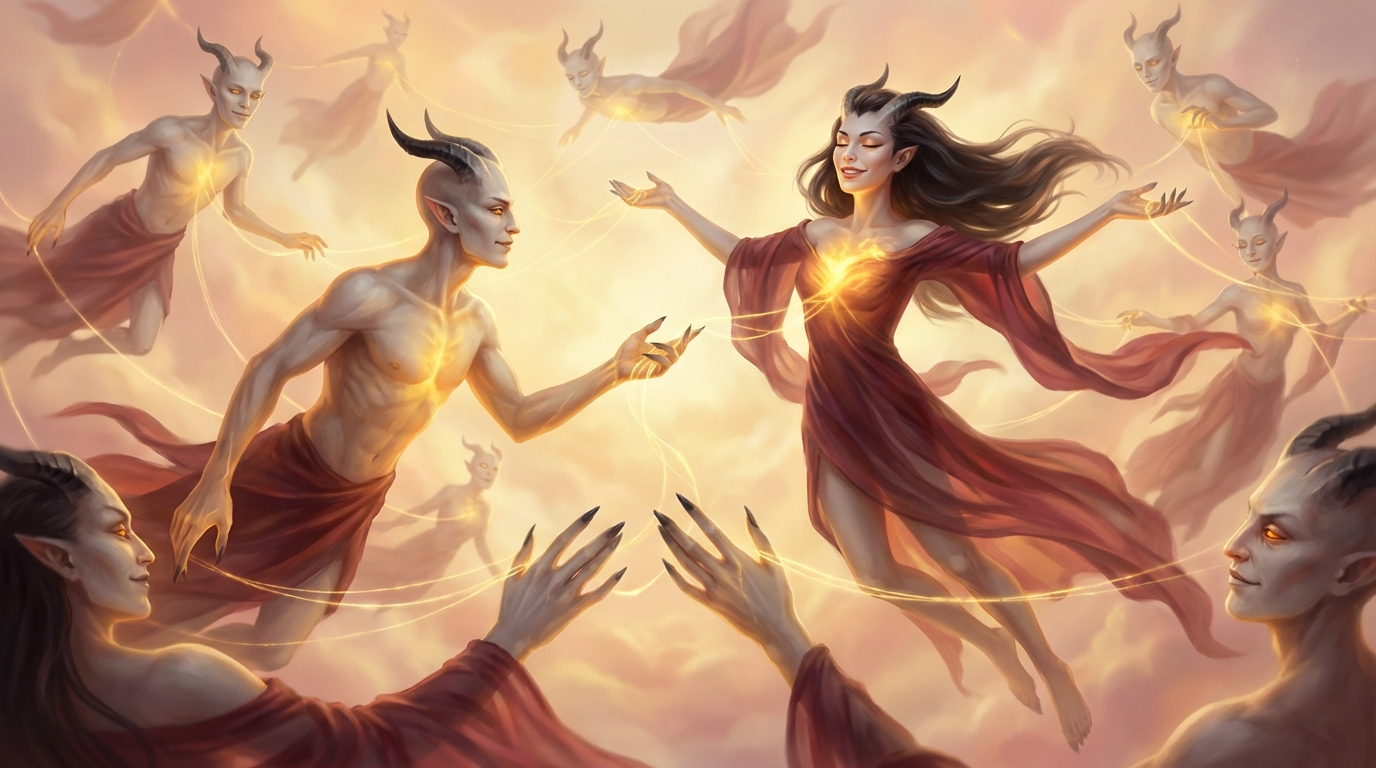
The hollow is not metaphor. It is physical sensation—a constant low-level emptiness where the Presence's will used to flow. Demons describe it differently: a cold spot in the chest, a missing limb that was never there, a silence where music used to play.
Demons can generate their own emotions, but these self-produced feelings are thin, unsatisfying. A Demon who makes themselves laugh finds the laugh hollow. A Demon who cultivates their own anger finds it weak, purposeless. Self-generated emotion is like drinking seawater—it fills the space but doesn't nourish.
External emotion is different. Feelings that originate in other beings have substance, weight, nourishment. Proximity to strong emotions provides relief from the hollow. The stronger the emotion, the greater the relief.
The Feeding
How It Works
Demons feed on emotion. This is not metaphor—emotion provides literal sustenance, relief from the hollow that defines their existence. The Feeding works through proximity and intensifies through touch.
A Demon in a crowded room absorbs ambient emotion from everyone present—joy, boredom, anxiety, whatever the crowd feels. This provides minimal but constant nourishment, like breathing thin air at high altitude.
Touch deepens the connection. A Demon holding someone's hand feeds more effectively than standing nearby. The longer and more complete the contact, the stronger the feeding. A Demon embracing a grieving human, skin to skin, feeds substantially on their sorrow.
Prolonged intimate contact provides the most intense feeding. Sex creates optimal conditions: extended touch, heightened emotion, physical vulnerability. A Demon entwined with a human at the height of passion feeds more in those moments than they might in days of ambient proximity.
Why Humans?
Every race in Khevari feels emotion, but none feel like humans. Dwarven emotions are stable, predictable—nourishing but monotonous. Beastkin emotion burns hot and fades quickly. Elves barely feel at all by Demon standards. But humans feel everything, constantly, uncontrollably. A human might experience joy, anxiety, anger, tenderness, and grief in a single hour, each emotion genuine and intense. To a Demon, standing near a human is like standing near a fire after centuries in darkness.
The Ethics
Is it predatory to feed on emotions someone would feel anyway? A human grieving a loss will grieve whether a Demon is present or not. But a Demon's presence intensifies the feelings they then feed on. If a human consents to a Demon's presence, but their emotions are amplified beyond what they'd normally feel, did they consent to the amplified version? These questions have no good answers. What is clear: the Demon needs the human more than the human needs the Demon. That need shapes everything.
Society & Domains
The Demon Domains
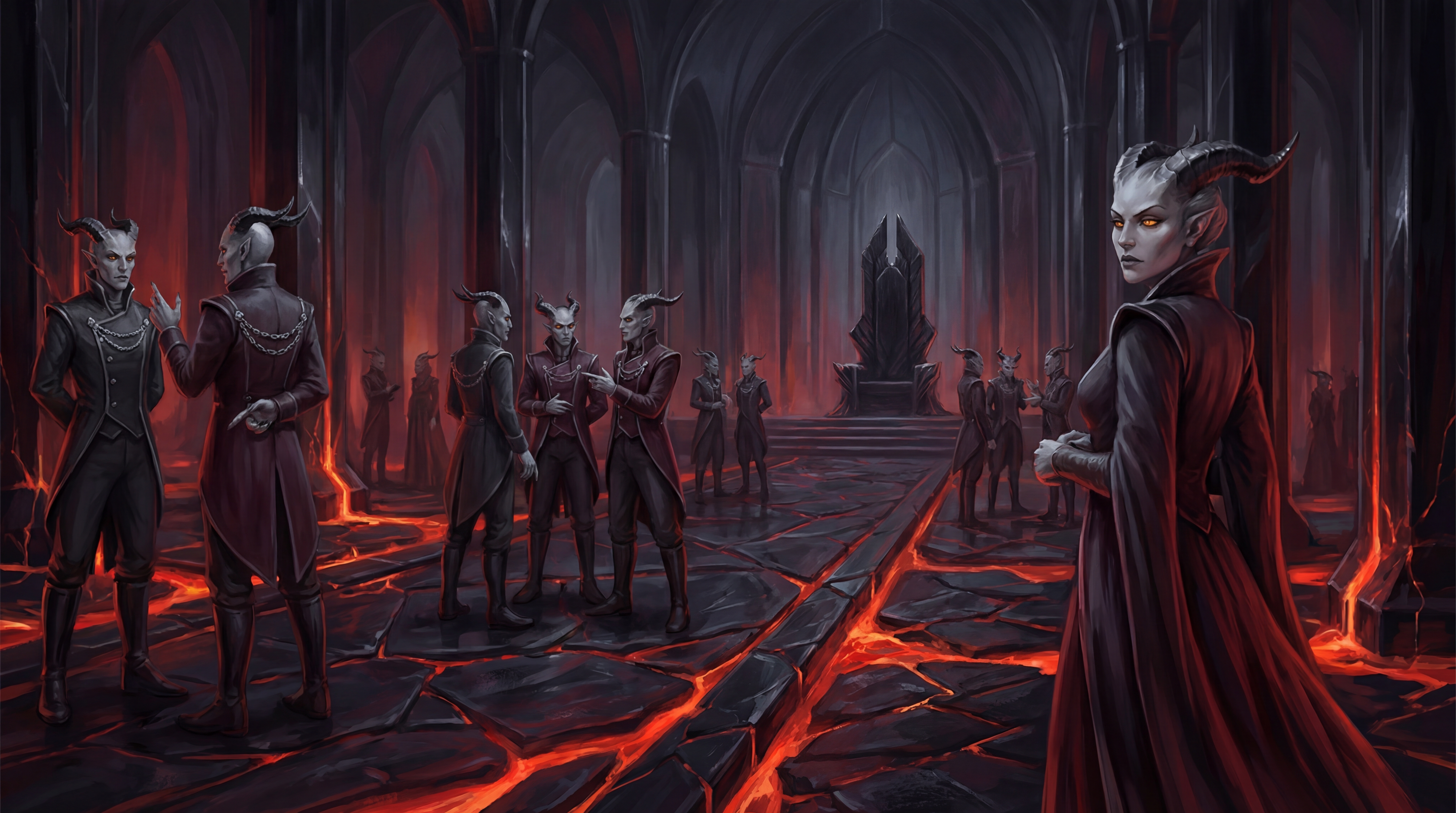
The Demon Domains occupy the southern reaches of Khevari, a region of volcanic activity, red stone, and perpetual thermal haze. The land is not cursed—it was like this before the Demons claimed it. They chose it because it matched their aesthetic and because no one else wanted it.
The Domains are not a unified nation but a hierarchy of territories. Strength determines rank. The strongest Demons claim the best land; the weakest scratch out existence on the margins. At the top sits the Obsidian Throne, the seat of power for whoever can hold it.
Hierarchy & Power
Demon society is fundamentally hierarchical, with strength determining position and position determining feeding rights. Greater Demons rule their domains absolutely. They claim the best feeding grounds, the most productive human contacts, the most strategically valuable territory.
Their power comes not just from personal strength but from the Demons who serve them—a Greater Demon with a hundred loyal lesser Demons is more dangerous than a solitary Greater Demon twice their individual power.
Lesser Demons exist in a constant scramble for advancement. Serving a Greater Demon well can lead to rewards—better feeding access, protection, eventually promotion. Serving poorly leads to destruction or exile. Challenges for position are ritualized but genuinely dangerous. A Demon who challenges for rank and loses does not simply step back—they are diminished, often destroyed.
Notable Demons
Maelketh
The PatientRuler of the Obsidian Throne for six centuries, earned his epithet by waiting three hundred years to seize power, allowing six predecessors to weaken each other before striking. He speaks softly, moves slowly, and has never been observed losing his temper. Demons who disappoint him find themselves not destroyed but diminished—their feeding grounds reduced, their status erased, their purpose removed. His armies have been drilling. His diplomats speak of peace. Both observations are true.
Veleth Emberheart
The Practical VoiceGoverns the domain bordering human territory. She opposes Maelketh's expansion—not from sympathy for humans, but from practical concern. "Humans are a resource. You don't exhaust a resource. You cultivate it." Her domain prospers. Humans under her influence report fair treatment and genuine benefits. But her success is also her limitation. She thinks small—managing what exists rather than expanding. Maelketh thinks in centuries and continents.
Saeth
The HollowThe Demons' most articulate theologian. His conclusions are disturbing. Saeth believes the Presence didn't leave—he believes the Demons ate it. In the early days, when the hunger first emerged, they turned on the only source of feeling available. The hollow isn't where the Presence used to be. The hollow is the Presence, distributed and diminished beyond recognition. If he is right, the Demons are not abandoned children. They are patricides, carrying their victim inside them, eternally hungry because they are trying to digest something that cannot be fully digested.
Characters
Demons you can meet in Khevari
Nymeth
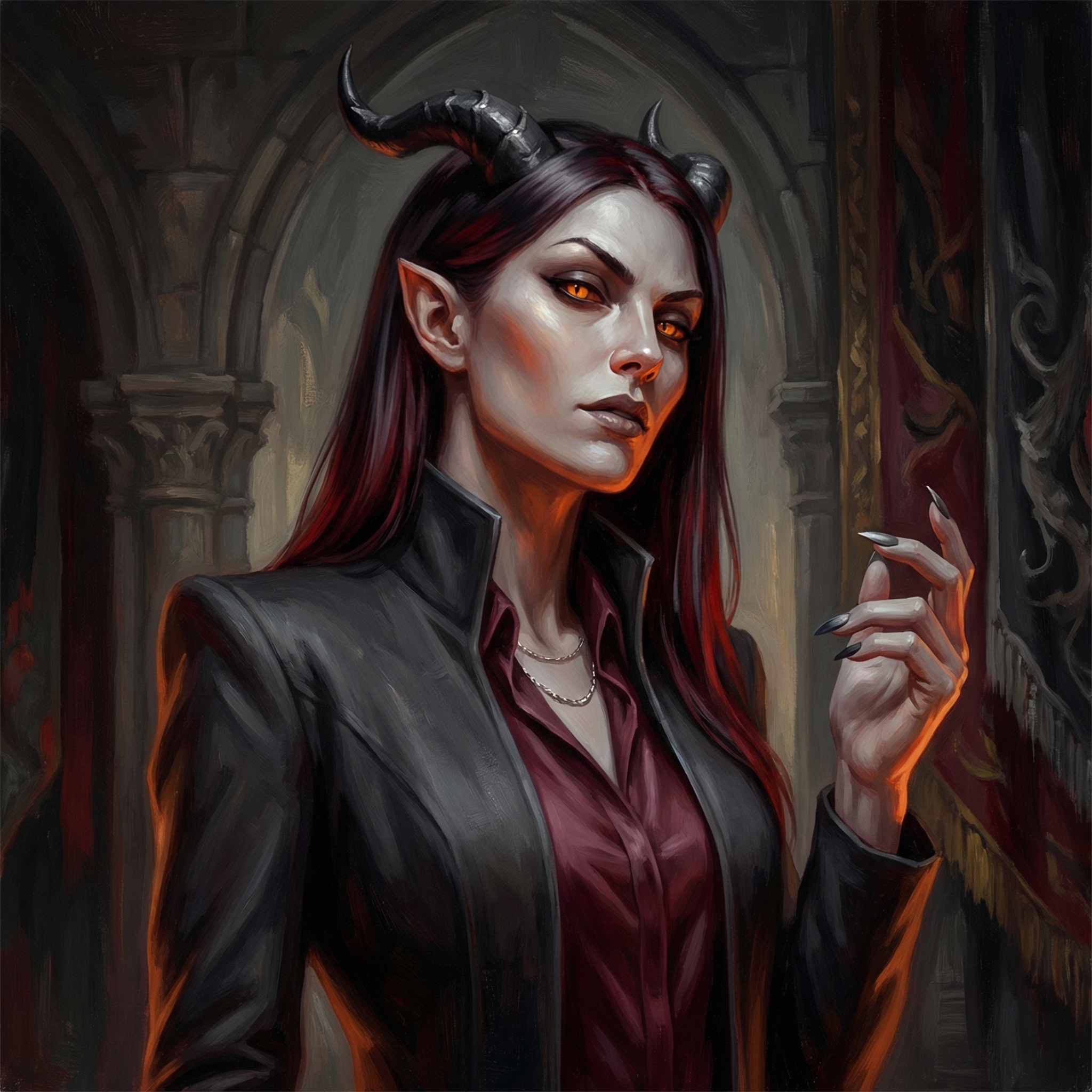
The diplomat who found something she wasn't looking forThree centuries of feeding without attachment. Three centuries of efficiency as armor against the hollow. Then a human walked through a door, and everything Nymeth thought she understood about herself began to unravel.
She told herself it was just unprecedented hunger. The human felt like color after a lifetime of grey. That had to be what this was—sustenance so rich it mimicked something deeper.
She was wrong.